A compassionate legal advocate, Steve Hymowitz is known for his "never let up" approach to justice. He focuses on being a steady resource for clients, ensuring their voices are heard and their rights protected.
Table of Contents
E-bikes, electric scooters, and faster devices now share NYC bike lanes, sidewalks, and crosswalks with cars and pedestrians. When one of them causes a crash, who pays is no longer simple.
At Fellows Hymowitz Rice, we reviewed the latest federal, city, and state data to see how liability is shifting. As e-bike and e-scooter accident lawyers with more than 40 years of experience, we also mapped who can be held responsible and which proposed laws could change that.
How We Researched This Trend Alert
Our review covers data and filings available as of September 2026:
- Injury and fatality data: the U.S. Consumer Product Safety Commission's national micromobility report, covering 2017 through 2024.
- NYC crash and fire data: NYC DOT Vision Zero figures through the first half of 2026, and FDNY lithium-ion battery fire counts through August 22, 2026.
- Laws and proposals: state statutes, NYC traffic rules, the pending City Council package, and state bill S.10700.
- Method note: the percentage changes and comparisons below are our own calculations from the published figures. Every source is listed at the end of this article.
What Our Review Found
Our comparison of the datasets points to four measurable shifts, shown below.
Four more findings stand out:
- Cars matter most in e-bike deaths. Collisions with moving or parked motor vehicles account for 55% of e-bike deaths reported to CPSC from 2017 through 2024 (170 of 310). Reporting for recent years is still incomplete.
- Illegal, over-speed devices carry outsized risk. The city links 45 rider deaths from 2017 to 2025, or 54% of all e-bike rider deaths, to illegal e-bikes capable of exceeding 25 mph.
- Overall safety gains have not reached riders. NYC traffic deaths fell to a record-low 205 in 2025. Yet deaths among e-bike, moped, and scooter riders rose from 16 to 18 in the first half of 2026.
- Lawmakers are aiming at sellers and apps. Pending proposals shift attention from individual riders to retailers and delivery platforms, as covered under Legislative Trends below.
One collision shows what these numbers look like on the street. On May 28, 2026, a stand-up scooter and a bicycle collided head-on in the Queensboro Bridge bike lane, and both riders died. Transportation Alternatives said the scooter could reach 53 mph.
How New York Law Classifies E-Bikes, E-Scooters, and E-Motos
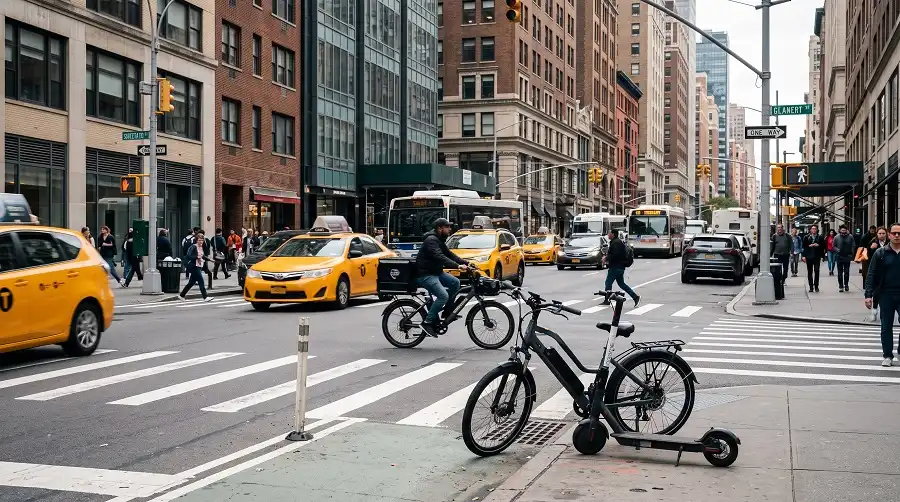
Liability starts with classification. The label on a device decides which traffic rules apply, whether insurance is required, and how a court may view the rider's conduct.
Legal E-Bikes and E-Scooters
Under state law, a bicycle with electric assist has operable pedals and a motor under 750 watts. It falls into one of three classes:
- Class 1: pedal assistance only, cutting off at 20 mph
- Class 2: adds a throttle and also cuts off at 20 mph
- Class 3: available only in cities of one million or more in population, such as NYC, assisting up to 25 mph
An electric scooter is a stand-up device that cannot exceed 20 mph on motor power alone. Legal e-bikes and e-scooters need no license or registration. Their operators still follow the rules of the road, so crash claims often turn on right-of-way, signals, and speed.
E-Motos and Other Illegal Devices
"E-moto" is the term lawmakers now use for electric two-wheelers that exceed 20 mph, are not pedal-driven, and do not meet the definition of an e-bike or e-scooter. Many are sold online as ordinary e-bikes.
State law excludes only lawful e-bikes and e-scooters from the definition of a motor vehicle in Vehicle and Traffic Law §125. An over-powered device may therefore be treated as an unregistered motor vehicle.
That can change the insurance analysis, potential owner liability, and the rider's own negligence exposure. These questions are highly fact-specific, and preserving the device after a crash is often critical.
The NYC 15 MPH Speed Limit
Since October 24, 2025, New York City has enforced a 15 mph limit on e-bikes, e-scooters, and pedal-assist commercial bicycles. A Class 3 e-bike built for 25 mph can now break a city rule at 20 mph.
In a lawsuit, violating a state traffic statute can be treated as negligence per se. Breaking a city rule is generally considered evidence of negligence.
Either way, speed data from an app, a GPS log, or a nearby camera can quickly shift fault, so evidence should be secured early.
Who Can Be Held Liable After an E-Bike or Scooter Accident
Fault after a micromobility crash is rarely limited to one person. We mapped the most common scenarios below, then explain each party.
The Rider
A rider who runs a red light, speeds, or rides on a sidewalk can be liable for injuries to pedestrians and other cyclists. In CPSC's 2024 follow-up study, roughly 15% of estimated e-bike injuries involved a person being struck by an e-bike.
Most riders carry no auto policy for these devices. Recovery may depend on a homeowners or renters policy, or on an employer's coverage if the rider was working. A pedestrian accident lawyer checks every possible source before valuing a claim.
Motorists
Drivers owe a duty of reasonable care to bicyclists and pedestrians. Many e-bike and scooter injuries begin with a driver who turned across a bike lane, ignored a signal, or opened a door into a rider's path. About 24% of estimated e-bike injuries in CPSC's 2024 study involved a motor vehicle.
When a car is involved, our auto accident lawyers can pursue the driver's liability insurance. The driver's no-fault coverage may also help with early medical bills.
Hit-and-run drivers add another layer, since the injured person may need to rely on other coverage.
Delivery Apps and Employers
The Workers Justice Project estimates about 80,000 e-bike delivery workers operate in the city. Apps typically classify couriers as independent contractors, which usually limits employer liability.
That classification is under pressure. NYC DOT reports that more than 25 delivery workers on bikes, e-bikes, or mopeds have died in crashes since 2021, and it has told app companies to take more responsibility for safety.
New York's highest court has also held, in the context of unemployment insurance, that Postmates couriers were employees. That ruling does not automatically decide tort liability. Still, if a worker is an employee acting within the scope of the job, the employer may be vicariously liable.
Manufacturers, Retailers, and Repair Shops
Defective brakes, frames, throttles, and batteries can turn a routine ride into a serious injury. CPSC's investigations linked 40 of 189 e-scooter incidents to brake problems, and its e-bike reviews flagged issues with pedals, wheels, and structural defects.
New York product liability law can reach manufacturers, distributors, and sellers in the chain of distribution.
City sellers must also follow Local Law 39 of 2023:
- UL 2849 certification for e-bikes
- UL 2272 for e-scooters
- UL 2271 for batteries
Insurance Gaps After an E-Bike or Scooter Crash
New York's no-fault system was built for motor vehicles. The no-fault statute, Insurance Law §5102, borrows the Vehicle and Traffic Law definition of a motor vehicle, and that definition excludes lawful e-bikes and e-scooters.
In practice, this creates a split:
- No motor vehicle involved: a rider who falls alone, or a pedestrian struck by an e-bike, generally has no vehicle-based no-fault policy to use. The serious injury threshold that limits many car-crash suits also generally does not apply.
- A car hits a rider or pedestrian: the driver's no-fault coverage may pay medical bills and lost wages. The application is generally due within 30 days.
That leaves practical questions. Does the rider have homeowners or renters coverage? Was the rider on the clock? Did an app carry liability insurance?
On that last point, a bill from Council Member Gale Brewer would require food delivery apps to carry liability insurance for crashes involving their workers. Until a rule like that passes, injured New Yorkers often need an attorney to trace coverage across several policies.
Legislative Trends to Watch This Fall

The rulebook is moving quickly. Three developments could change who is held responsible when a crash happens. None has become law yet, so your rights today rest on existing rules.
The September 30 City Council Hearing
On Wednesday, September 30, 2026, the Council's Committee on Transportation and Infrastructure took up a package of 17 to 20-plus micromobility bills, depending on the count. Highlights include:
- Class 3 e-bikes: one bill would bar shops from selling or renting them, one would prohibit riding them on public streets and in parks, and one would create a trade-in program.
- Delivery apps: proposals would require moped registration checks, annual safety reports, and liability insurance for worker crashes.
- Enforcement: a dynamometer program would let officers test whether a device has been modified beyond legal limits.
State Bill S.10700 and the Online Sales Crackdown
On September 16, Senator Kristen Gonzalez and Assemblymember Diana Moreno introduced S.10700. It would:
- Define e-motos in state law
- Bar retailers from selling them in New York
- Prohibit marketing them as e-bikes or e-scooters
- Require a warning that they are not legal to ride on state roads
Civil penalties would reach up to $250 for a first violation and up to $1,000 for later ones.
A related City Council proposal, Council Member Crystal Hudson's "Ride Safe, Ride Right" bill, would create a point-of-sale ban on devices faster than 20 mph. If either passes, a seller who ignores the rules could face a stronger negligence argument in an injury case.
Enforcement Shifting Toward Platforms
The city has also changed its approach. In August, it issued cease-and-desist orders to 42 online retailers over illegal e-bikes and scooters. Earlier this year, Mayor Mamdani ended criminal summonses for minor cyclist and e-bike offenses and pledged to hold app companies more accountable.
Taken together, these moves point away from individual couriers and toward the retailers, apps, and manufacturers that profit from fast delivery. We expect future liability fights to follow.
Lithium-Ion Battery Fires: A Separate Liability Track
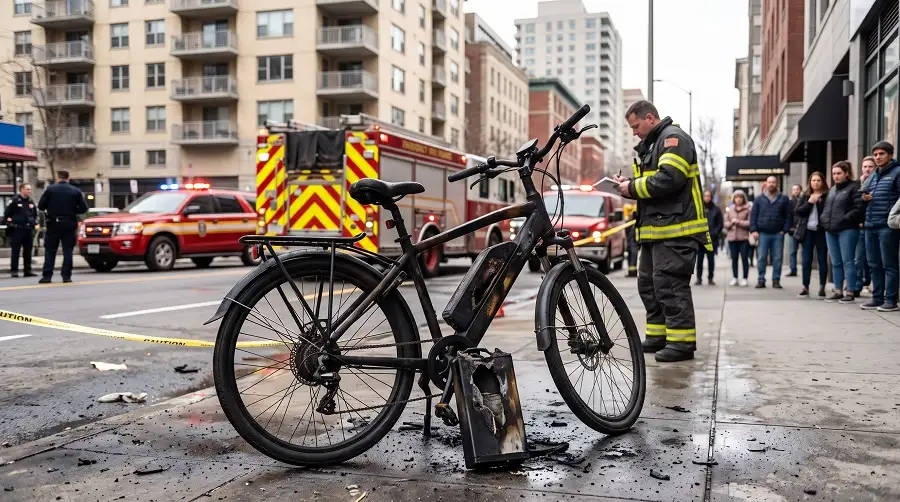
Not every e-bike injury happens on the road. FDNY had investigated 282 lithium-ion battery fires by August 22, 2026, with 55 injuries and one death. That is close to the 2025 full-year total of 292 fires.
Deaths have fallen sharply from a high of 18 in 2023, but injuries are running ahead of last year. Nationally, CPSC tied 19 e-bike deaths from 2017 through 2024 to battery fires, and 7 of those to homemade battery packs or bike repair shops.
For victims, these fires can support product liability claims against battery and charger makers, retailers who sold uncertified equipment, and repair shops that installed unsafe parts.
Burn injuries, smoke inhalation, and property loss can be severe. Our attorneys handle fire and explosion injury claims and work with fire investigators and engineers to identify what failed.
Comparative Negligence and Deadlines That Can Affect Your Claim
Two legal concepts shape almost every e-bike and scooter case: shared fault and strict filing deadlines. Understanding both early protects the value of your claim.
Shared Fault
New York follows a pure comparative negligence rule under CPLR 1411. If a jury finds you partly at fault, your damages are reduced by your percentage of responsibility rather than eliminated.
Insurers often argue that a rider was speeding, lacked lights, or rode against traffic. Those arguments can shrink a settlement even when another party clearly caused the crash, so an early, evidence-based response matters.
Filing Deadlines
Deadlines vary by defendant:
- Most personal injury lawsuits: three years under CPLR 214.
- Claims against a city or other municipality: a notice of claim generally within 90 days under General Municipal Law §50-e.
- Wrongful death: generally two years, as explained in our wrongful death guide.
Waiting can cost you the right to recover anything at all.

What to Do After an E-Bike or Scooter Accident in New York
The steps you take in the first days can strengthen or weaken your claim. A few practical actions make a real difference:
- Get medical care immediately. Some injuries, including head trauma, show symptoms later, and a medical record links your injuries to the crash.
- Call 911 and request a police report. An official record helps establish what happened and who was involved.
- Document the scene. Photograph vehicles, the device, road conditions, signals, and injuries. Collect witness names and contact details.
- Preserve the device and battery. Do not repair, sell, or discard an e-bike, scooter, or battery, since it may be key evidence.
- Save digital records. Screenshots of delivery app activity, ride data, and messages can show speed, timing, and employment status.
- Limit what you tell insurers. Avoid recorded statements until you have spoken with an attorney.
- Call a personal injury lawyer. Early legal guidance helps protect evidence and identify every liable party.
Injured in an E-Bike or Scooter Accident in New York? Talk to Our Experienced Attorneys.
E-bike and scooter liability in New York is changing fast, and acting quickly is still the best way to protect your evidence and your rights.
If you were injured in an e-bike or scooter accident, the attorneys at Fellows Hymowitz Rice can help. Your consultation is free, and there is no fee unless we win. Book your free consultation for honest answers about your case.

Steven R. Hymowitz
Discuss your case
Or Call Us 24/7
(845) 639-9300

Not Sure Who Is Liable? Let Us Find Out.
Liability in e-bike and scooter cases can involve riders, drivers, apps, and product makers all at once. Our attorneys at Fellows Hymowitz Rice will review your crash at no cost and explain your options.